- Artist/Maker:
- Alex Israel
- Bio:
- b. 1982, Los Angeles, California
- Title:
- Self-Portrait (Mom)
- Date:
- 2016
- Medium:
- Acrylic and industrial paint on fiberglass
- Dimensions:
- 96 × 84 × 4 in. (243.8 × 213.4 × 10.2 cm)
- Credit Line:
- Gift of the artist
- Accession Number:
- 2017-73
On View
The work of Los Angeles native Alex Israel is inextricable from the myths and culture of his hometown. Los Angeles, synonymous with Hollywood, and Hollywood a metonym for the American film industry, all began in that centrally located neighborhood marked by a sign that demarcates its hills like a white picket fence around a suburban home. The Hollywood Sign was originally built in 1923 to announce a new housing development called “Hollywoodland,” and it has remained in-situ ever since, an enduring symbol of hopes and dreams. At the core of Israel’s work in traditional media such as painting, sculpture, and installation, and extending to entertainment and commercial enterprises such as the talk show AS IT LAYS, the feature film SPF-18, and a line of sunglasses called Freeway, is the notion of the American Dream; an idea that anyone from anywhere, with a combination of hard work and luck, can rise up from a Nobody to a Somebody. Nowhere is that concept more alive and well than in Los Angeles, where countless flock to become a star—or to at least look like one.
Israel’s paintings are made on the Warner Brothers Studio backlot, within the scenic art department’s workshop. Backdrop painters have become largely unemployed as a result of digital printing, and now Israel, rather than Warner Brothers, is the department's biggest client. Their talents make the fakeness of Hollywood feel so real, and our shared willingness—and sometimes need-- to believe in artifice is essential to Israel’s art.
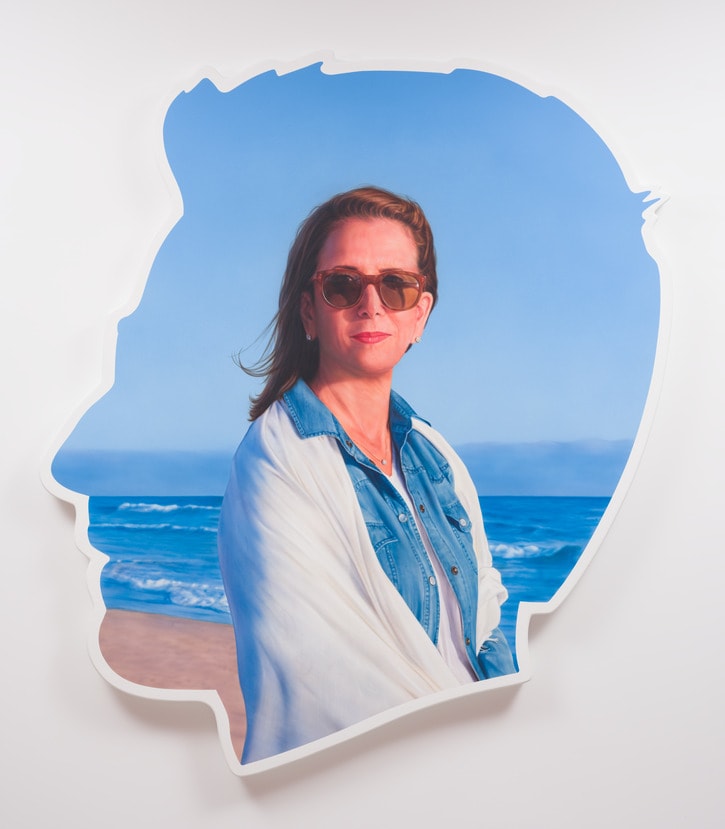
Self-Portrait (Mom) is a painting of the artist’s mother made within an outsized silhouette of his head in profile. It was executed in the traditional Hollywood scenic-style, a combination of airbrush and brushwork. The Self-Portraits first appeared in 2012 as the logo for AS IT LAYS and subsequently evolved into a series of paintings executed in airbrushed acrylic on fiberglass panels. Painted within each Self-Portrait are scenes and symbols fundamental to picturing Los Angeles: The Dodgers, a palm tree, a director’s chair. Israel enacts a not-so-subtle branding by intertwining his own image with those of the city, one that echoes the silhouette of a big apple, filled in with New York City’s most iconic buildings.
Self-Portrait (Mom) shows Israel’s mother standing on a beach, a timelessly elegant, mature woman who looks confident and comfortable with her place in the world. It feels like the example photo in a store-bought frame, or one appropriated from the all-American, aspirational advertisements of Ralph Lauren. Lauren was born Ralph Lifshitz in the Bronx, and he built one of the world’s most successful lifestyle brands that encompasses clothing, fragrances, and home goods. The preponderance of successful Jews in the New York garment industry parallels those in Hollywood. Warner Brothers was founded in the early 1900s by Jewish immigrants, and Jews continue to be Hollywood power-players to this day. Their success represents one of the culture’s greatest assimilation stories, an excellent example of the American Dream that preoccupies the imagination of Israel, also of Jewish descent.
Indeed, characters from television and film have propagated Jewish stereotypes, including the yiddishe mameh (Jewish mother). She is loving, yet smothering, and offers unsolicited food, observations, and advice to her children as she simultaneously riddles them with guilt. Examples include cringe-worthy characters like Sylvia, Fran Drescher’s materialistic, whiny mother in The Nanny, and on the flip side, the ultra groovy Roz Focker from the film Meet the Fockers. Israel’s Mom stands in stark contrast to both, she speaks more to the ideals of ease and beauty than to struggle and eccentricity.
The “portrait of the artist’s mother” has a long and notable art historical tradition. Perhaps its most celebrated example is the American artist James McNeil Whistler’s Symphony in Grey and Black, No. 1 (1871), also known as Whistler’s Mother. A stark study in color and composition, Whistler’s unsentimental rendering of the most sentimental of subjects was considered radical, even offensive in its time. But perhaps more than any other example, Self-Portrait (Mom), with its subject’s body slightly turned, glint of a smile across her lips, the horizon line just meeting her shoulders, evokes the most iconic of all female portraits, Leonardo da Vinci’s Mona Lisa (1503-04). Israel manipulates the Hollywood machine to fabricate his own legend, and Self-Portrait (Mom) raises his mother from an unknown to a glossy icon. It is also a double portrait, a story of mother and child, of bringing the artist into the world and fostering his talents.
Israel’s paintings are made on the Warner Brothers Studio backlot, within the scenic art department’s workshop. Backdrop painters have become largely unemployed as a result of digital printing, and now Israel, rather than Warner Brothers, is the department's biggest client. Their talents make the fakeness of Hollywood feel so real, and our shared willingness—and sometimes need-- to believe in artifice is essential to Israel’s art.
Self-Portrait (Mom) is a painting of the artist’s mother made within an outsized silhouette of his head in profile. It was executed in the traditional Hollywood scenic-style, a combination of airbrush and brushwork. The Self-Portraits first appeared in 2012 as the logo for AS IT LAYS and subsequently evolved into a series of paintings executed in airbrushed acrylic on fiberglass panels. Painted within each Self-Portrait are scenes and symbols fundamental to picturing Los Angeles: The Dodgers, a palm tree, a director’s chair. Israel enacts a not-so-subtle branding by intertwining his own image with those of the city, one that echoes the silhouette of a big apple, filled in with New York City’s most iconic buildings.
Self-Portrait (Mom) shows Israel’s mother standing on a beach, a timelessly elegant, mature woman who looks confident and comfortable with her place in the world. It feels like the example photo in a store-bought frame, or one appropriated from the all-American, aspirational advertisements of Ralph Lauren. Lauren was born Ralph Lifshitz in the Bronx, and he built one of the world’s most successful lifestyle brands that encompasses clothing, fragrances, and home goods. The preponderance of successful Jews in the New York garment industry parallels those in Hollywood. Warner Brothers was founded in the early 1900s by Jewish immigrants, and Jews continue to be Hollywood power-players to this day. Their success represents one of the culture’s greatest assimilation stories, an excellent example of the American Dream that preoccupies the imagination of Israel, also of Jewish descent.
Indeed, characters from television and film have propagated Jewish stereotypes, including the yiddishe mameh (Jewish mother). She is loving, yet smothering, and offers unsolicited food, observations, and advice to her children as she simultaneously riddles them with guilt. Examples include cringe-worthy characters like Sylvia, Fran Drescher’s materialistic, whiny mother in The Nanny, and on the flip side, the ultra groovy Roz Focker from the film Meet the Fockers. Israel’s Mom stands in stark contrast to both, she speaks more to the ideals of ease and beauty than to struggle and eccentricity.
The “portrait of the artist’s mother” has a long and notable art historical tradition. Perhaps its most celebrated example is the American artist James McNeil Whistler’s Symphony in Grey and Black, No. 1 (1871), also known as Whistler’s Mother. A stark study in color and composition, Whistler’s unsentimental rendering of the most sentimental of subjects was considered radical, even offensive in its time. But perhaps more than any other example, Self-Portrait (Mom), with its subject’s body slightly turned, glint of a smile across her lips, the horizon line just meeting her shoulders, evokes the most iconic of all female portraits, Leonardo da Vinci’s Mona Lisa (1503-04). Israel manipulates the Hollywood machine to fabricate his own legend, and Self-Portrait (Mom) raises his mother from an unknown to a glossy icon. It is also a double portrait, a story of mother and child, of bringing the artist into the world and fostering his talents.
Information may change as a result of ongoing research.